


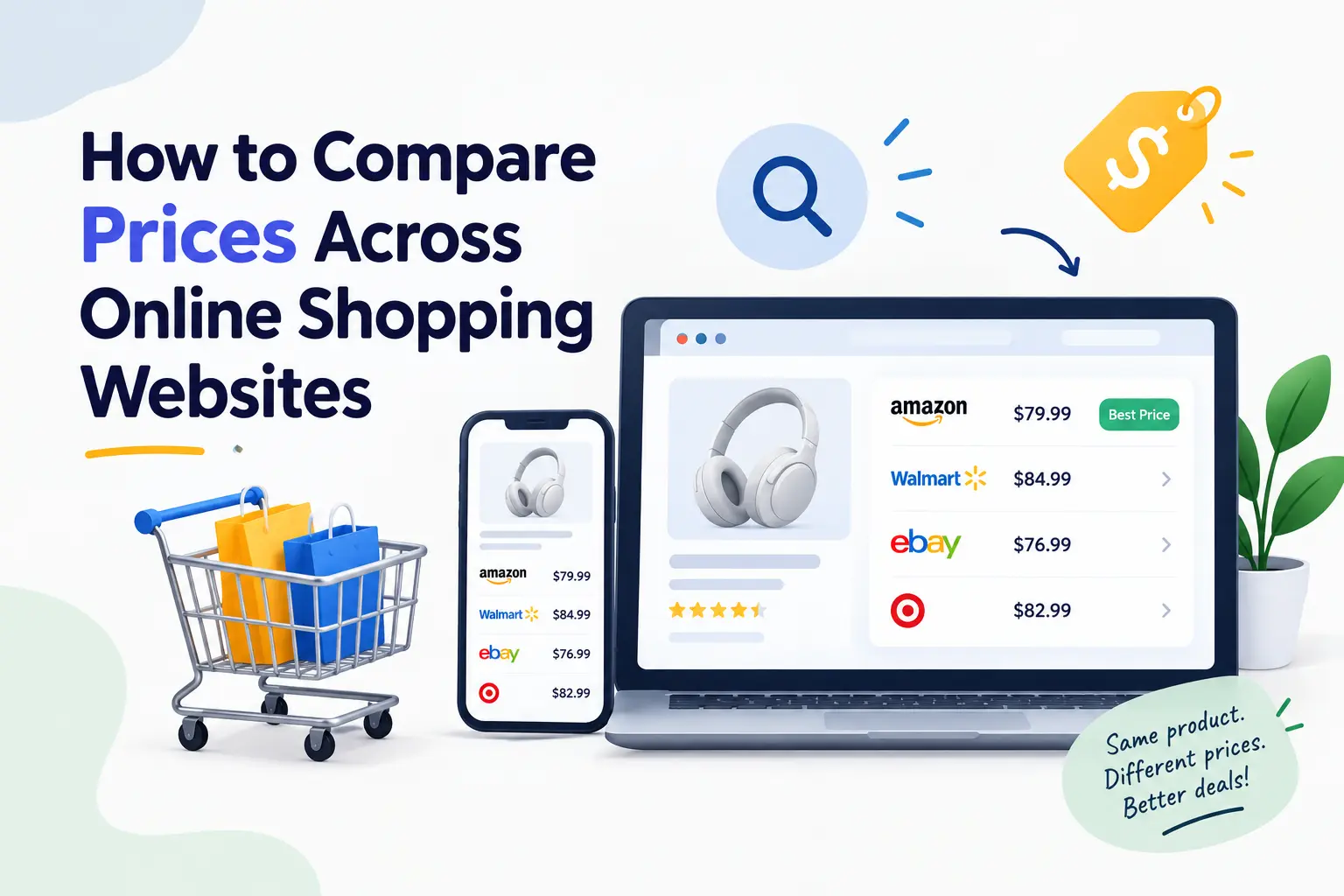



Online shopping makes it easy to find almost any product, but prices can vary significantly between websites. The same smartphone, headphones, home appliance, or fashion item may be available at different prices depending on the retailer, ongoing discounts, delivery fees, and payment offers.
Learning how to compare prices across online shopping websites can help you save money and make smarter purchasing decisions. Instead of buying from the first store you visit, you can explore multiple options and find the best overall deal.
In this guide, we’ll explain how to compare product prices, which tools can help, and what to check before placing an order.
1. Search for the Same Product on Multiple Websites
The easiest way to start comparing prices is to search for the exact product on several online shopping platforms.
For example, if you want to purchase a smartphone, check its price on Amazon, Walmart, Best Buy, or other retailers available in your region. In India, you might compare listings on Amazon India, Flipkart, Croma, and Reliance Digital.
Make sure you compare the same model, storage capacity, color, size, and version. Two products may look identical but have different specifications or included accessories.
Tip: Use the product’s exact name or model number when searching. This helps you avoid comb paring similar-looking products with different features.
2. Use Price Comparison Websites and Tools
Manually checking several websites can take time. Price comparison tools simplify the process by collecting product listings and displaying prices from multiple retailers.
Depending on your country and product category, useful options include:
- Google Shopping: Helps you discover products and compare retailer listings.
- PriceGrabber: Offers product price comparisons in supported markets.
- ShopSavvy: Provides product comparison features and barcode-based shopping tools where available.
- Keepa: Helps track Amazon product prices and review historical price trends.
- Local price comparison tools: These may help you understand price differences across retailers in your region.
These tools have different retailer coverage, features, and regional availability. Always confirm the final price directly on the retailer’s website before purchasing.
3. Compare the Final Price, Not Just the Product Price
One of the most common online shopping mistakes is choosing the product with the lowest displayed price without checking additional costs.
The final amount you pay may include shipping charges, taxes, service fees, or other expenses. Some retailers also offer discounts that apply only when you meet specific conditions.
For example, one store might list a product for ₹4,999 with free delivery and a ₹200 coupon, while another lists it for ₹4,799 with a ₹100 delivery fee.
After applying the coupon and adding delivery costs, the first store’s final price would be ₹4,799, while the second store’s final price would be ₹4,899.
Before checking out, compare the final payable amount after applying eligible discounts and accounting for delivery charges.
4. Check Coupons, Bank Offers, and Cashback
Online retailers frequently provide promotional offers, including coupon codes, bank discounts, loyalty rewards, and cashback.
However, these offers may have minimum purchase requirements, card restrictions, expiration dates, or cashback conditions.
Before using an offer, check:
- Whether your payment method qualifies.
- Whether the discount is applied immediately or credited later.
- Whether a minimum spending amount is required.
- Whether the offer can be combined with other discounts.
- Whether any additional fees offset the savings.
Calculate the actual benefit rather than relying on the advertised discount percentage.
5. Check Price History Before Buying
A product advertised at a large discount is not necessarily at its lowest price.
Some retailers change prices frequently, especially during major shopping events. Checking historical prices can help you determine whether a deal is genuinely attractive.
Price tracking tools such as Keepa can show historical Amazon pricing for supported products. Other tools may offer price alerts or historical data for selected retailers.
If the current price is unusually high compared with its recent history, you may decide to wait for a better offer, provided the purchase is not urgent.
6. Compare Seller Ratings, Reviews, and Return Policies
The cheapest listing is not always the best choice. A low price may come with poor customer support, unclear warranty coverage, or complicated return conditions.
Before purchasing, review the seller’s ratings, customer feedback, shipping estimates, and return policy.
For electronics, check whether the product includes a manufacturer’s warranty and whether the seller is authorized where that matters. For clothing and footwear, pay attention to sizing, exchange policies, and return shipping costs.
Also check whether the product is new, refurbished, open-box, or used. These conditions can significantly affect its value.
7. Be Careful With Fake Discounts and Suspicious Websites
Online shopping scams can turn an apparent bargain into an expensive mistake.
Be cautious when a website offers a price far below the normal market range, displays unclear contact information, or pressures you to pay immediately.
Look for secure payment options, transparent policies, and trustworthy seller information. A padlock symbol in the browser alone does not guarantee that a store is legitimate.
Avoid making payments through unfamiliar methods when a retailer’s legitimacy is uncertain. Check independent reviews and verify the website address before entering personal or payment information.
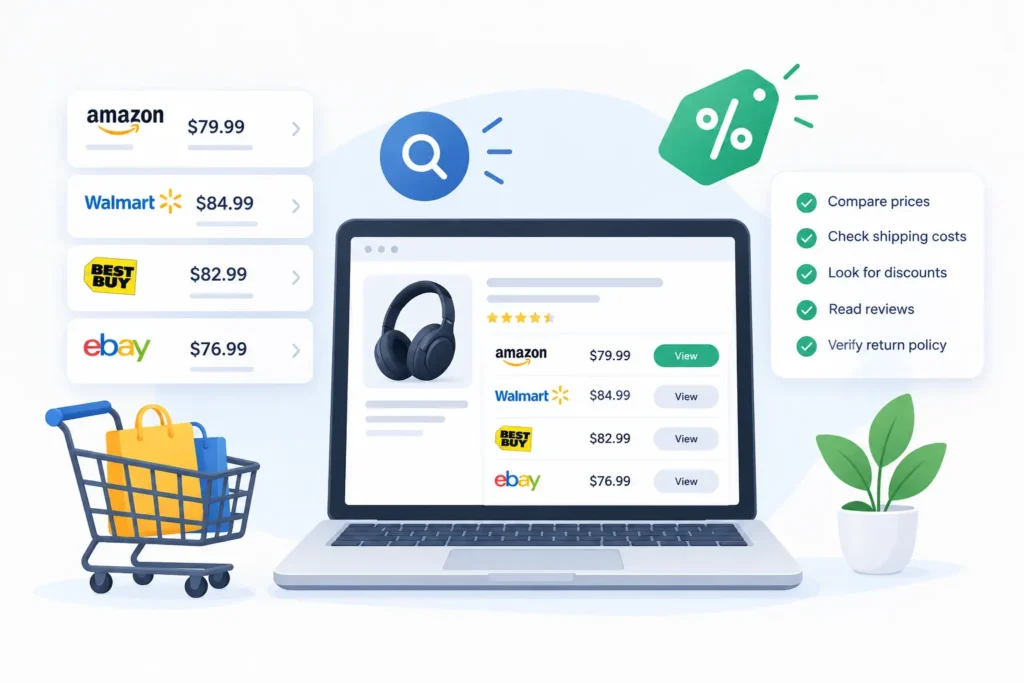
8. Create a Simple Price Comparison Checklist
Before making your final decision, review these important factors:
- Product specifications: Confirm that the model, size, and features match.
- Final price: Include shipping fees, taxes, and applicable discounts.
- Delivery time: Check when the product is expected to arrive.
- Seller reputation: Review customer feedback and seller information.
- Warranty and returns: Understand the coverage and return conditions.
- Price history: Check recent pricing if tracking tools are available.
Following this checklist helps you choose a product based on overall value rather than price alone.
Conclusion
Comparing prices across online shopping websites is a simple habit that can help you avoid overspending. By checking multiple retailers, using price comparison tools, calculating the final cost, reviewing discounts, and verifying seller reliability, you can make more informed buying decisions.
Remember that the cheapest product is not always the best deal. Consider product quality, warranty coverage, delivery costs, and customer service alongside the price.
Before your next online purchase, spend a few extra minutes comparing your options. Those small savings can add up over time and make your shopping experience more rewarding.